
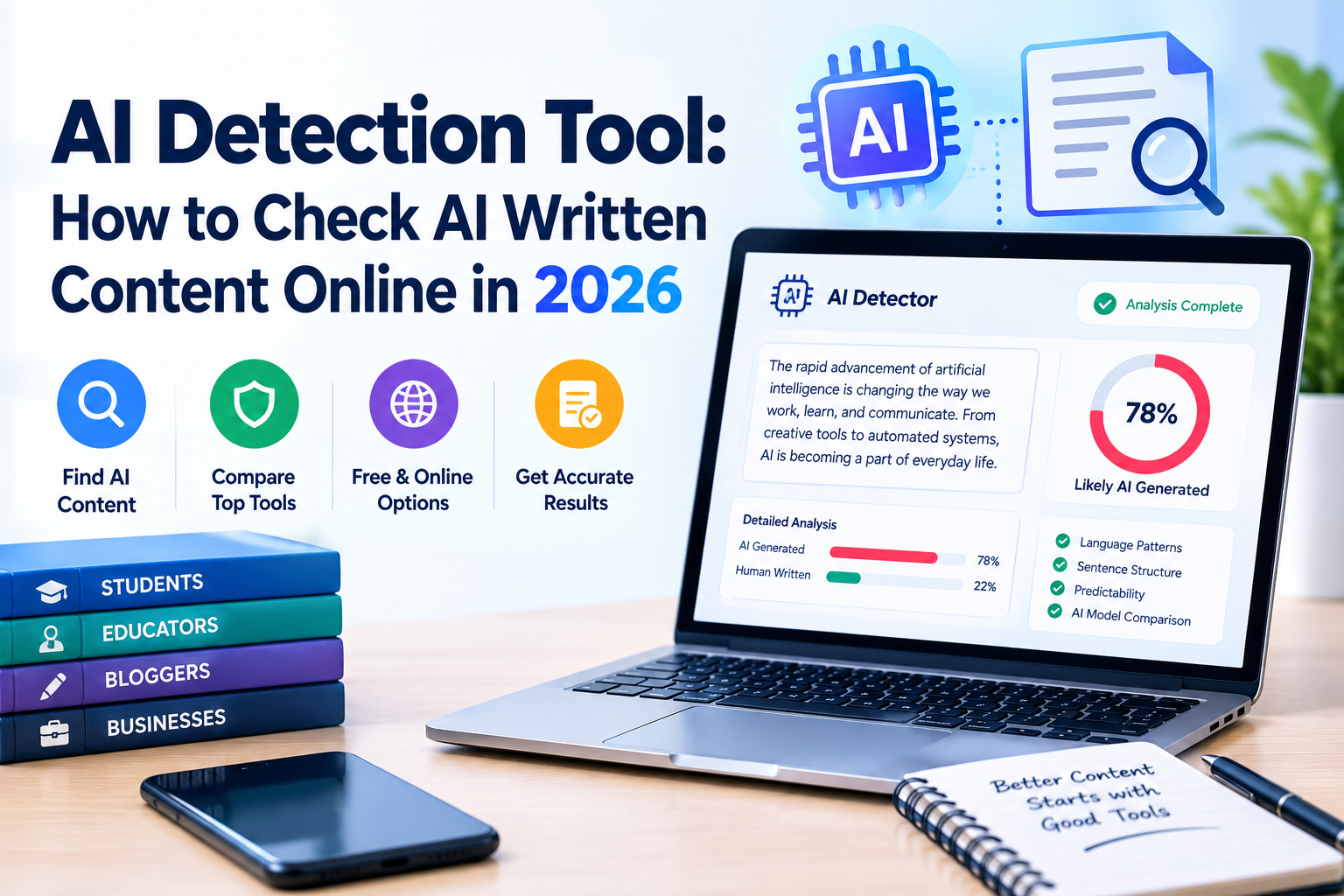
An AI detection tool helps analyze written content and estimate whether it may have been generated by artificial intelligence. These tools are increasingly used by students, teachers, editors, bloggers, businesses, and content publishers who want to understand how a piece of text was produced.
However, choosing an AI detection tool is not as simple as finding one that displays the highest accuracy percentage. Different tools use different detection methods, support different types of writing, and may produce different results for the same paragraph. A detector can also incorrectly flag human writing or fail to identify AI generated content.
If you want to check an essay, review a blog post, or explore an AI detection tool free of charge, it is important to understand what each option offers before relying on its results.
This guide explains how AI detection works, compares popular tools, explores free online options, and shares practical advice for interpreting detection scores.
What Is an AI Detection Tool?
An AI detection tool is software that analyzes text and estimates the likelihood that the content was generated or modified by an artificial intelligence system. It may examine language patterns, sentence structure, word predictability, and other statistical features to produce a score or classification.
For example, a teacher might use an AI writing detector to review an essay, while a website editor might use one as an additional quality control step before publishing an article.
AI detectors are designed to provide an estimate, not definitive proof of who wrote a document. A detection score should therefore be considered alongside the writing process, source material, document history, and other relevant evidence.
Who Uses AI Detection Tools?
Common users include:
- Students and writers: To understand how their own writing is classified by detection software.
- Teachers and educators: To support a broader review of submitted assignments.
- Bloggers and publishers: To review content during editorial quality checks.
- Businesses and agencies: To assess written material as part of their content workflows.
The appropriate use depends on the tool, its privacy policy, and the consequences of the decision being made.
How Does an AI Detection Tool Work?
An AI detection tool generally processes a text sample and compares its characteristics with patterns learned from human written and AI generated examples.
Although the exact technology varies between providers, the process commonly includes the following stages.
1. Text Analysis
The software examines the submitted writing. Depending on the detector, it may analyze word choices, sentence patterns, predictability, and variations in writing style.
2. Pattern Evaluation
The system compares these characteristics with patterns associated with the material used to develop or train its detection model. Some tools also analyze sections of text individually rather than evaluating the entire document as one unit.
3. Score Generation
The tool produces a result, such as a probability estimate, a percentage of text classified as likely AI generated, or a simple label.
These scores are not necessarily equivalent across tools. A 70% result from one detector does not automatically mean another detector would produce the same result.
4. Human Review
The final step is interpreting the result in context. Reviewers should consider the document’s purpose, writing history, supporting sources, and any applicable rules before making a decision.
A useful AI detection tool supports informed review. It should not replace careful judgment.
Best AI Detection Tools in 2026
The best AI detection tool depends on whether you need a quick free check, an educational workflow, or content review features for a publishing business.
The following options are worth evaluating. Their features and access limits may change, so check each provider’s official website before using or purchasing a service.
1. GPTZero

Best for: Educational writing review
GPTZero is an AI writing detection service associated with checking essays, articles, and other written material. It is worth considering if you want to review text in an educational or writing focused workflow.
Potential reasons to evaluate it include:
- AI writing analysis for submitted text.
- Features designed around educational and writing workflows.
- Tools and plans that may vary by account type.
Before choosing GPTZero, review its current access limits, supported formats, and explanation of detection results. Do not assume that a particular score proves that a student or writer used AI.
Official website: https://gptzero.me/
2. Winston AI
Best for: Publishers and professional content workflows
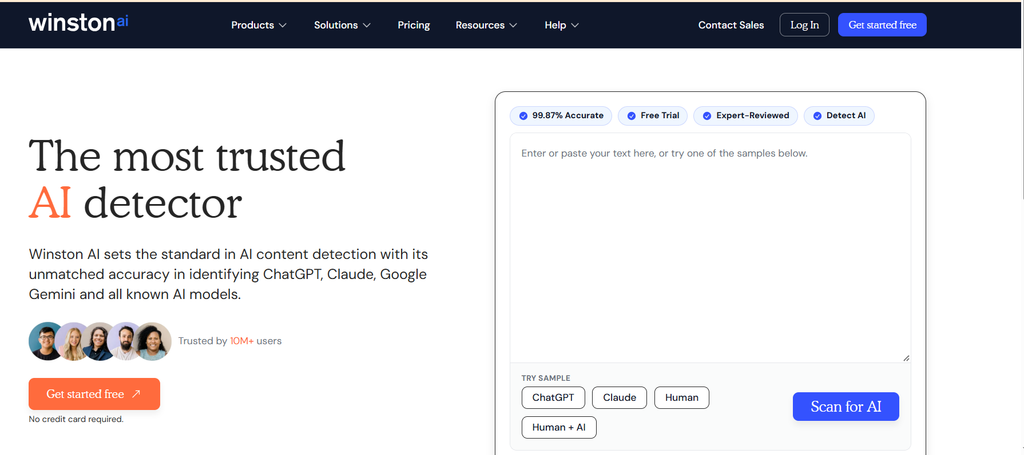
Winston AI provides AI content detection features for users who want to assess written material. It may be useful to publishers, agencies, and teams that need more than a basic single text check.
Consider evaluating:
- Its AI text detection workflow.
- Available document review and reporting features.
- Current subscription limits and supported content types.
Check the current plan details before subscribing because available features and prices can change.
Official website: https://gowinston.ai/
3. Originality.ai

Best for: Website owners and content editors
Originality.ai is aimed at content professionals and publishers who want to evaluate written content. It is a relevant option for website owners who include content review in their publishing process.
Depending on the current plan, investigate whether you need AI detection, plagiarism checking, site scanning, or team features.
Its results should still be treated as estimates rather than definitive evidence about authorship. A high score alone does not establish that an article is inaccurate, unoriginal, or unsuitable for publication.
Official website: https://originality.ai/
4. Copyleaks
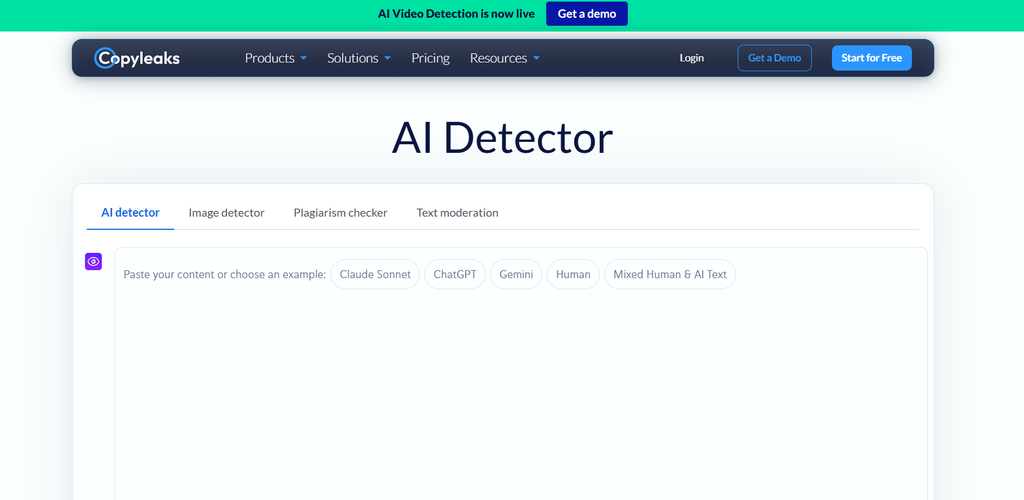
Best for: Organizations and multilingual content review
Copyleaks offers AI content detection and plagiarism related services. It may be appropriate for organizations that need structured review workflows or support for different languages.
Before using it, check:
- Whether your language is supported by the relevant detector.
- Whether the available plan fits your document volume.
- What happens to submitted text under its data handling policy.
Language support and performance can differ, so test the service using material similar to the writing you actually need to review.
Official website: https://copyleaks.com/
5. Turnitin AI Writing Detection
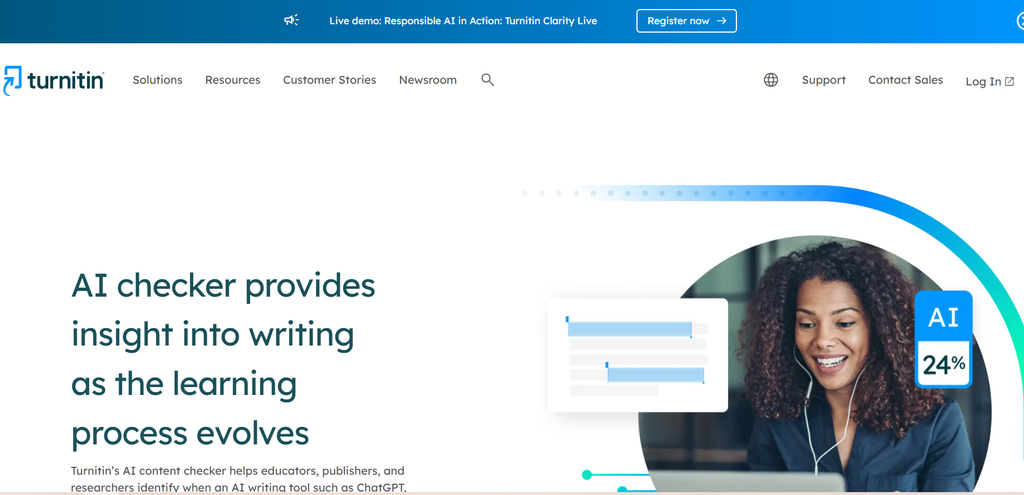
Best for: Schools and academic institutions with access
Turnitin provides AI writing detection features within eligible institutional workflows. It is particularly relevant to educators and institutions that already use Turnitin for academic integrity processes.
Important considerations include:
- Access is generally managed through participating institutions.
- AI writing detection is separate from a traditional similarity score.
- Turnitin itself warns that its AI writing detection may misidentify human written or AI generated text.
Turnitin advises that AI detection should not be the sole basis for adverse action against a student. Human review and institutional policies remain important. See its official guidance on using the AI Writing Report.
AI Detection Tools Comparison Table
| Tool | Best suited for | What to check |
|---|---|---|
| GPTZero | Educational writing review | Current free access and reporting |
| Winston AI | Publishers and professional teams | Available plans and review features |
| Originality.ai | Website owners and editors | AI detection and additional content checks |
| Copyleaks | Organizations and multilingual workflows | Language support and plan limits |
| Turnitin | Eligible educational institutions | Institutional access and report interpretation |
This is a practical shortlist, not a laboratory tested ranking. The tools have not been independently tested against the same controlled dataset for this article, so the table does not claim that one has the highest detection accuracy.
Free AI Detection Tool Online Options
If you want an AI detection tool free of charge, start by checking whether a provider currently offers a free tier, limited scan, trial, or sample analysis.
Free access varies by service and can change over time. Some providers restrict the number of words, scans, or features available without payment.
What Should You Look for in a Free AI Detector?
Ease of use: A straightforward interface makes it easier to submit text and understand the result.
Word limits: Check how much text you can analyze in one scan and whether a daily or monthly limit applies.
Result explanations: A useful report should explain what its score represents rather than simply labeling the text as AI or human.
Privacy: Read the provider’s data policy before uploading essays, unpublished articles, client content, or confidential documents.
Language support: Confirm that the detector supports the language and type of text you want to check.
Can You Use an AI Detector Without Paying?
Yes, some providers offer limited free access or trial options, but the exact terms differ. Visit the official provider websites listed above to verify the current offer.
Do not select a service solely because it advertises free scans. Consider its privacy terms, output quality, and limitations as well.
How to Use an AI Detection Tool
Using an AI detection tool online is usually straightforward. Follow these steps to review a piece of writing responsibly.
Step 1: Prepare Your Text
Copy the relevant section of the essay, blog post, report, or other document. If the detector has a minimum word requirement, make sure your sample meets it.
Avoid uploading sensitive or confidential material unless you understand how the service handles submitted data.
Step 2: Open the Detector
Visit the official website of your chosen provider. Confirm that you are using the genuine service and review any available usage limits before submitting the text.
Step 3: Submit the Writing
Paste your text into the available input field or upload a supported document. Some tools may require an account, while others may offer a limited check without registration.
Step 4: Review the Results
Read the full report rather than focusing only on the headline score. Check whether the tool identifies particular passages, explains its classification, or provides limitations.
Remember that each service uses its own methods, so its score may not match the results from another AI detector.
Step 5: Evaluate the Evidence
If the result matters for a school assignment or professional decision, examine relevant evidence such as drafts, version history, research notes, citations, and the writer’s explanation.
For your own article, use the report as a prompt to review clarity, accuracy, originality, and supporting evidence. Do not rewrite accurate content merely to chase a particular detector score.
How Accurate Are AI Detection Tools?
AI detectors can be useful, but no result should be treated as a guaranteed determination of authorship. Performance varies depending on the detector, the text, the language, the writing style, and how the content was produced or edited.
A detector may classify AI generated writing as human written. It may also classify human writing as AI generated. These errors can matter, especially when a score is used to judge a student, employee, or freelance writer.
Turnitin’s own documentation acknowledges the possibility of misidentification and advises against using its AI report as the sole basis for adverse decisions. You can read its AI writing detection model guidance.
Why Can AI Detectors Produce Different Results?
Several factors may affect results:
- Short text samples: A small amount of writing may provide limited evidence for analysis.
- Predictable language: Formulaic, repetitive, or highly standardized writing may be classified differently from more varied prose.
- Editing and translation: Human editing, paraphrasing, or translation can change the characteristics of a text.
- Language differences: A detector may perform differently across languages and writing styles.
- Model updates: Providers can update their detection systems, changing results over time.
For these reasons, comparing multiple detectors may reveal uncertainty, but agreement between tools still does not prove authorship.
What Does an AI Detection Percentage Mean?
A percentage usually represents the detector’s own estimate or classification of the submitted text. It does not necessarily represent the probability that a particular person used AI.
For example, a report that labels 80% of a document as likely AI generated should not automatically be interpreted as an 80% chance that the named writer used AI. Check the provider’s documentation to understand exactly what the score measures.
AI Detection Tool vs. Plagiarism Checker
An AI detection tool and a plagiarism checker answer different questions. Some services offer both features, but the results should not be confused.
| Feature | AI detection tool | Plagiarism checker |
|---|---|---|
| Main purpose | Estimates whether text resembles AI generated writing | Finds text matching existing sources |
| Typical result | AI likelihood or classification | Similarity score and matching passages |
| Main limitation | Can misclassify human or AI writing | Similarity does not automatically prove plagiarism |
| Useful for | Reviewing writing patterns | Checking source overlap and attribution |
A piece of writing can be original but classified as AI generated. Likewise, human written text can contain unattributed copied material.
For a thorough content review, assess factual accuracy, source attribution, originality, and writing quality separately.
How to Choose the Right AI Detection Tool
The right choice depends on your actual use case rather than a single advertised accuracy claim.
For Students and Teachers
Consider the tool available through your institution and learn how its reports should be interpreted. Keep drafts, notes, and research records that help demonstrate how an assignment was developed.
For Bloggers and SEO Professionals
Choose a tool that fits your editorial workflow and budget. AI detection can be one optional review step, but it does not replace fact checking, helpful content, original insights, or editorial judgment.
For a website such as TechRivio, focus on whether an article is useful, accurate, well sourced, and written for readers. A detector score alone cannot determine whether a page deserves to rank in search results.
For Businesses and Agencies
Review data protection, team access, document limits, and integration requirements. If client content is confidential, check retention and privacy terms before uploading it.
Use This Simple Selection Framework
Apply the PURPOSE framework when choosing an AI detection tool:
- P — Purpose: Define why you need detection.
- U — Usability: Check whether the workflow is easy to use.
- R — Reporting: Understand how the tool explains its results.
- P — Privacy: Review data handling and retention policies.
- O — Options: Compare free access, paid plans, and usage limits.
- S — Support: Confirm language and file format compatibility.
- E — Evidence: Treat detection results as one signal, not a final verdict.
This framework helps you choose a tool based on your needs instead of relying on marketing claims.
Common Mistakes to Avoid When Using AI Detectors
Treating a Score as Proof
An AI detection result is an estimate, not conclusive evidence about who wrote a piece of text. High stakes decisions require additional review.
Assuming Every Tool Is Equally Reliable
Different tools use different models, training data, and reporting methods. Results from one service may not translate directly to another.
Uploading Confidential Material Without Checking Privacy
Before submitting unpublished research, client documents, or personal writing, review the provider’s privacy and data retention policies.
Rewriting Content Only to Change a Score
Trying to force a detector to return a preferred result can reduce clarity and introduce errors. Focus on making the writing accurate, original, transparent, and useful to its intended audience.
Frequently Asked Questions
What is the best AI detection tool?
There is no universally best AI detection tool for every task. GPTZero, Winston AI, Originality.ai, Copyleaks, and Turnitin each serve different workflows. Compare their current features, access requirements, privacy policies, and limitations before choosing.
Is there a free AI detection tool online?
Some providers offer free tiers, limited scans, or trials. Availability and word limits can change, so check the official websites for current terms.
Can an AI detection tool identify ChatGPT writing?
An AI detector may classify text as resembling writing produced by a large language model, including ChatGPT. However, it cannot guarantee that ChatGPT produced a particular passage or reliably identify the exact tool used.
Is Turnitin AI detection always accurate?
No. Turnitin acknowledges that its model can misidentify human written and AI generated text. Its guidance recommends human judgment and says the report should not be the sole basis for adverse action against a student.
Can human written content be flagged as AI generated?
Yes. This is known as a false positive. A detector’s result may be affected by writing style, language, sample length, and the model’s limitations.
Does an AI detection score prove plagiarism?
No. AI detection and plagiarism checking measure different things. A detector score does not establish that content was copied, and a similarity score does not automatically establish plagiarism.
Should bloggers use an AI detection tool before publishing?
They may use one as an optional editorial check, but it should not be the main measure of article quality. Accuracy, useful information, reliable sources, originality, and reader experience are more important to the publishing process.
What is the difference between AI detection and humanizing AI text?
AI detection attempts to estimate whether text resembles AI generated writing. Humanizing tools attempt to revise text to sound more natural or conversational. Neither process guarantees a particular detector result, and editing should prioritize clarity and accuracy rather than evading a detection system.
Conclusion
An AI detection tool can help writers, educators, publishers, and businesses review written content, but its results need careful interpretation. The right tool depends on your use case, budget, language, privacy requirements, and preferred reporting features.
GPTZero, Winston AI, Originality.ai, Copyleaks, and Turnitin are useful options to investigate, but no single detector should be treated as an unquestionable authority. Check current features directly with each provider and remember that detection scores can contain errors.
For the most responsible approach, combine an AI detection tool with source verification, writing history, editorial review, and human judgment. This gives you a more complete understanding of the content than relying on a percentage alone.