

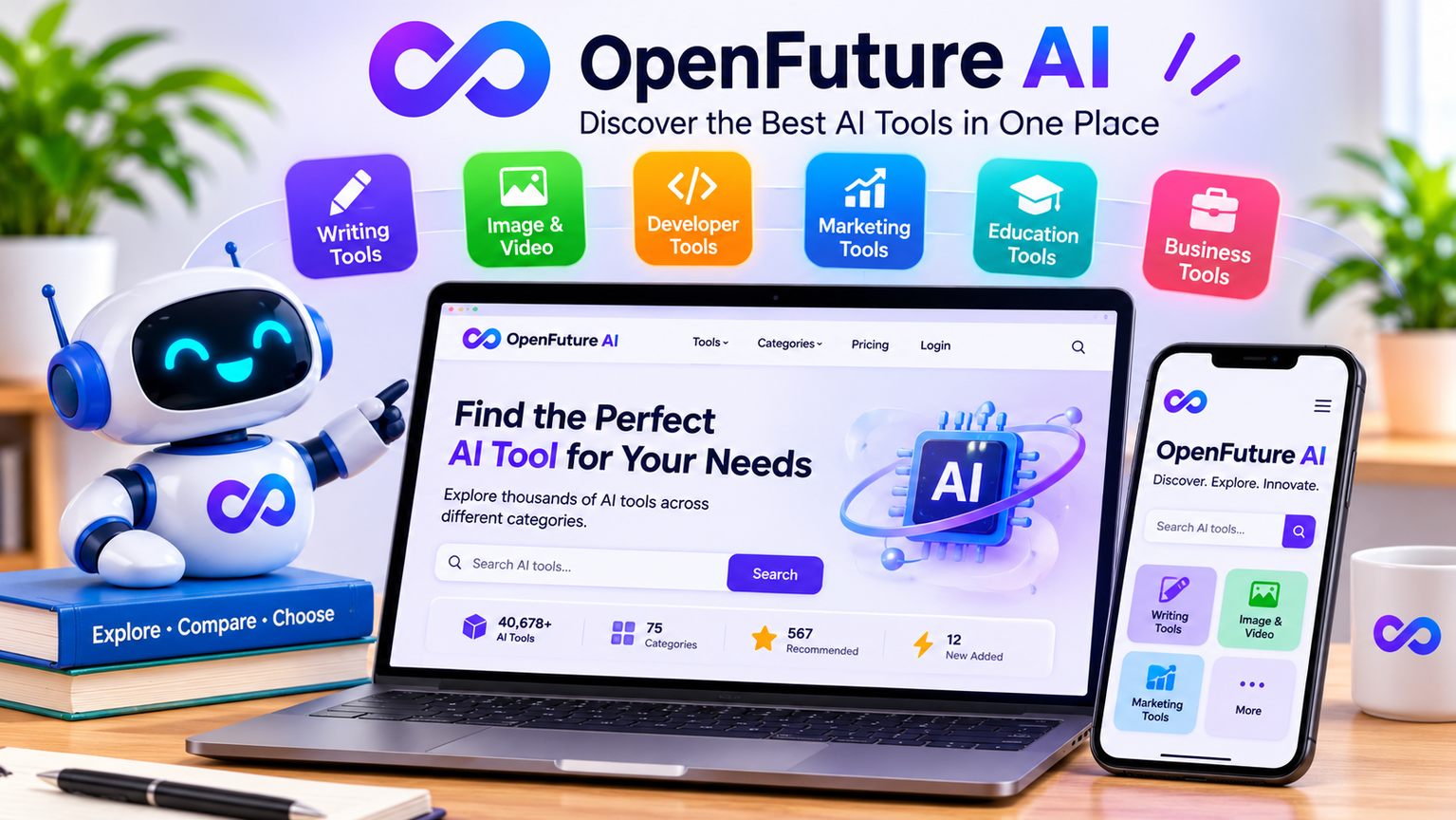
OpenFuture AI is an online directory that helps people discover artificial intelligence tools for different tasks. Instead of visiting multiple websites to find AI software, users can explore thousands of listings in one place. The platform covers areas such as productivity, marketing, content creation, coding, education, image generation, and business automation.
If you’re looking for new AI tools but aren’t sure which platform can meet your needs, OpenFuture AI can be a useful starting point. It allows you to browse tools by category, search for specific solutions, and check available pricing information. However, finding a tool through a directory doesn’t automatically mean it’s the right choice. You should still check its features, pricing, and privacy policies before using it.
What Is OpenFuture AI?
OpenFuture AI is an AI tools directory designed to make discovering artificial intelligence software easier. It brings together listings from different developers and companies, allowing users to explore available products without searching across dozens of websites.
The platform isn’t itself an AI chatbot, writing assistant, or image generator. Instead, it works more like a search engine for AI software. You can find a tool that matches your requirements, read its description, review its pricing label, and visit the provider’s website to learn more.
According to the platform’s listing page, it currently organizes more than 40,000 tools across 75 categories. These numbers can change as new products are added and existing listings are updated. All Ai Tools In One Place!+1
How Does OpenFuture AI Work?
OpenFuture AI works through a searchable directory. You don’t need to understand complicated AI technology to use it. Simply identify the task you want to complete and explore the relevant tools.
For example, someone looking for help with writing can explore writing and copywriting categories. A developer can browse coding assistants, while a business owner may look for marketing or productivity software.
The basic process is straightforward:
- Open the OpenFuture AI platform.
- Enter the name of a tool or the task you want help with.
- Browse the available results and categories.
- Check each listing’s description and pricing information.
- Select a tool to visit its provider’s website.
- Review its terms and features before creating an account or purchasing a plan.
The directory helps you discover possible solutions, but the actual tools are provided by separate companies. Their registration processes, features, and subscription requirements may differ.
Main Features of OpenFuture AI
The platform focuses on making AI software easier to discover. Its main features are related to searching, browsing, categorizing, and organizing tool listings.
1. Large AI Tools Directory
One of its main attractions is its extensive collection of AI software. The directory includes tools for personal tasks, professional projects, education, marketing, development, and creative work.
Having different solutions in one place can save research time. Instead of relying on a single recommendation, you can explore several options and decide which one deserves further attention.
2. Search Function
The search feature helps users find tools based on their names or descriptions. If you already know what type of software you need, searching can be faster than browsing every category.
For instance, you might search for an AI presentation maker, video editor, research assistant, or coding tool. The platform then displays relevant listings to explore.
3. Category-Based Browsing
OpenFuture AI organizes tools into different categories. Its listed categories include:
- Productivity and developer tools
- Marketing and SEO
- Image generation and editing
- Video generation and editing
- Writing and copywriting
- Education and research
- Finance and health
- E-commerce and business
This structure is useful when you know the problem you want to solve but haven’t selected a particular product.
4. Pricing Filters
Not every AI tool has the same pricing model. Some offer free access, while others provide limited free plans or require payment.
OpenFuture AI includes pricing filters that help users narrow down their search. The available labels include:
| Pricing label | What it means |
|---|---|
| Free | Listed as free to use |
| Freemium | Free access with paid upgrades |
| Free Trial | A trial is available |
| Paid | Requires payment |
| Contact for Pricing | Pricing details require contacting the provider |
| Price Unknown | Pricing information isn’t available |
These labels are useful for initial research, but you should always confirm the latest cost on the tool provider’s website. A free listing doesn’t necessarily mean every feature is free.
5. Recommended and Recently Added Tools
The directory also has separate sections for recommended tools and newly added products. These sections help users discover software they might not find through a specific search.
The Recommended section displays selected listings, while New Added highlights recently included tools. However, a recommendation or recent listing should be treated as a discovery suggestion, not proof that a product is independently tested or suitable for every user. All Ai Tools In One Place!+1
6. Favorites and Account Access
Users can browse the directory without immediately creating an account. The platform also displays Google and Discord login options. Signing in can be useful for account-based features such as saving favorite tools.
This gives users a simple way to explore the available listings before deciding whether they want to create an account.
What Types of AI Tools Can You Find?
OpenFuture AI covers a wide range of use cases. The best category depends on what you want to accomplish.
AI Writing and Content Creation
Writing tools can help users prepare drafts, improve sentences, generate ideas, and create marketing content. Bloggers, content creators, and marketing professionals may find this category useful.
However, AI-generated content still needs human editing and fact-checking. A tool’s listing alone cannot establish the quality or originality of its output.
AI Image and Video Tools
Creative professionals can explore tools for image generation, image editing, video creation, and related visual tasks. These products may support social media content, presentations, advertising, and personal projects.
Before choosing one, compare its output quality, usage limits, commercial rights, and subscription costs.
Developer and Coding Tools
Developers can search for coding assistants and other software development solutions. Depending on the product, these tools may help with code generation, debugging, documentation, or workflow support.
It’s important to review generated code before using it in a live project, particularly when security and user data are involved.
Productivity and Business Tools
This category can help individuals and organizations discover software for everyday work. Examples include task management, automation, email assistance, research, and business operations.
The right choice depends on your existing workflow, required integrations, and budget.
Is OpenFuture AI Free to Use?
Yes, browsing the OpenFuture AI directory is free. You can explore categories, search for tools, and review available listings without purchasing a directory subscription.
However, this doesn’t mean all the products listed on the platform are free. Each third-party provider decides its own pricing model. Some products offer free plans, others provide trials, and some require a paid subscription.
Before signing up for any listed service, check its current pricing page, cancellation terms, and feature restrictions. This is especially important if you plan to use an AI product for business or long-term projects.
Is OpenFuture AI Safe and Legit?
OpenFuture AI is a functioning website that provides a directory of AI software. You can use it to discover products, but it’s important to understand the difference between browsing a directory and trusting every product listed in it.
A listing doesn’t guarantee that the provider is reliable, that its software works as advertised, or that it handles personal information safely. Third-party tools have their own owners, privacy policies, and security practices.
Before using a product, consider these precautions:
- Check the developer’s official website and contact information.
- Read its privacy policy before sharing personal or business data.
- Review subscription terms and cancellation conditions.
- Look for independent user reviews where available.
- Avoid entering payment details on unfamiliar or suspicious websites.
OpenFuture AI is best treated as a discovery platform rather than a security certification or independent testing service. Fastio+1
Advantages and Disadvantages of OpenFuture AI
Like other AI directories, OpenFuture AI has benefits and limitations. Understanding both can help you decide whether it fits your research process.
| Advantages | Disadvantages |
|---|---|
| Large collection of AI tools | Some descriptions provide limited detail |
| Multiple categories | Listings may vary in quality |
| Search and pricing filters | Pricing information can change |
| Recommended and new listings | Recommendations aren’t a guarantee |
| Free directory browsing | Actual tools may require payment |
| Easy product discovery | No substitute for detailed product testing |
Its biggest advantage is convenience. You can explore different types of AI software without starting every search from scratch. Its main limitation is that a directory listing doesn’t provide all the information needed to make a confident purchasing decision.
Best OpenFuture AI Alternatives
OpenFuture AI isn’t the only platform for discovering artificial intelligence software. Depending on your requirements, you may also want to explore other directories.
Futurepedia
Futurepedia is an AI tools discovery platform that helps users explore software across different categories. It can be useful when you want another source for finding AI products and comparing available options.
Toolify
Toolify is another directory focused on AI applications. Users can explore different tools and discover products for writing, productivity, marketing, and creative tasks.
There’s An AI For That
There’s An AI For That focuses on connecting users with AI tools for specific tasks. It’s particularly useful when you know what you want to accomplish but don’t know which product can help.
Which Alternative Should You Choose?
The best platform depends on your search requirements. You can use OpenFuture AI for broad directory browsing and compare its results with other platforms before selecting a product. No single directory should be your only source when choosing software for an important project.
Who Should Use OpenFuture AI?
OpenFuture AI can be useful for people who regularly explore new software or want to find AI solutions for specific tasks.
Content creators and bloggers can use it to discover writing, editing, image, and video tools. Students and researchers may find educational and research-related software. Developers can explore coding assistants, while business owners and marketers can search for automation, productivity, and marketing solutions.
It’s also suitable for beginners who want to understand what types of AI software are available. However, users who already have a trusted set of tools may not need to browse a large directory regularly.
Tips for Choosing the Right AI Tool
Finding a product is only the first step. You should evaluate it carefully before making it part of your daily workflow.
Start with your actual requirement. Decide whether you need help with writing, research, design, coding, automation, or another task. A clear purpose makes it easier to filter irrelevant results.
Compare more than one option. Check the features, pricing, limitations, and user feedback of several products. Don’t choose a tool only because it appears in a recommended section.
Test before paying. If a provider offers a free plan or trial, use it to evaluate the product. Check whether it delivers the results you need and works with your existing software.
Review privacy and ownership terms. If you plan to upload documents, customer information, or business files, understand how the provider collects, stores, and uses that information.
Frequently Asked Questions
What is OpenFuture AI used for?
OpenFuture AI is used to discover artificial intelligence software. It organizes tools into categories and provides search and pricing filters to help users find products for different tasks.
Is OpenFuture AI an AI chatbot?
No. OpenFuture AI is an AI tools directory, not a chatbot. It helps users find separate AI applications and visit their providers’ websites.
Is OpenFuture AI free?
Yes, browsing its directory is free. However, individual tools listed on the platform may have free, freemium, trial-based, or paid plans.
Do I need an account to use OpenFuture AI?
You can browse its tool directory without signing in. The platform also offers Google and Discord login options for account-based features.
How many AI tools are listed on OpenFuture AI?
The directory displayed more than 40,000 listings across 75 categories when checked in November 2026. The total can change as the platform adds or updates products.
Can I find free AI tools on OpenFuture AI?
Yes. You can use the pricing filters to find listings marked as free. However, check each provider’s website to confirm whether its important features are available without payment.
Is OpenFuture AI safe to use?
The directory can be used for discovering AI products, but you should evaluate each third-party provider separately. Review its privacy policy, security information, and payment terms before sharing sensitive information.
Does OpenFuture AI create AI content?
No. The platform lists tools that may create content, images, videos, or other outputs. You need to visit the individual provider to use those services.
Final Thoughts
OpenFuture AI makes it easier to explore the growing range of artificial intelligence software. Its searchable directory, category filters, pricing labels, and recently added listings provide a convenient starting point for finding tools for work, education, creativity, and business.
Still, discovering a product isn’t the same as verifying its quality. Take time to compare alternatives, check the provider’s official information, and understand its pricing and privacy policies before committing to a subscription. Used as a research starting point, OpenFuture AI can help you discover software that may fit your needs.


